SOC 2 • ISO 27001 • Internal Audit • Compliance Readiness • Evidence Management
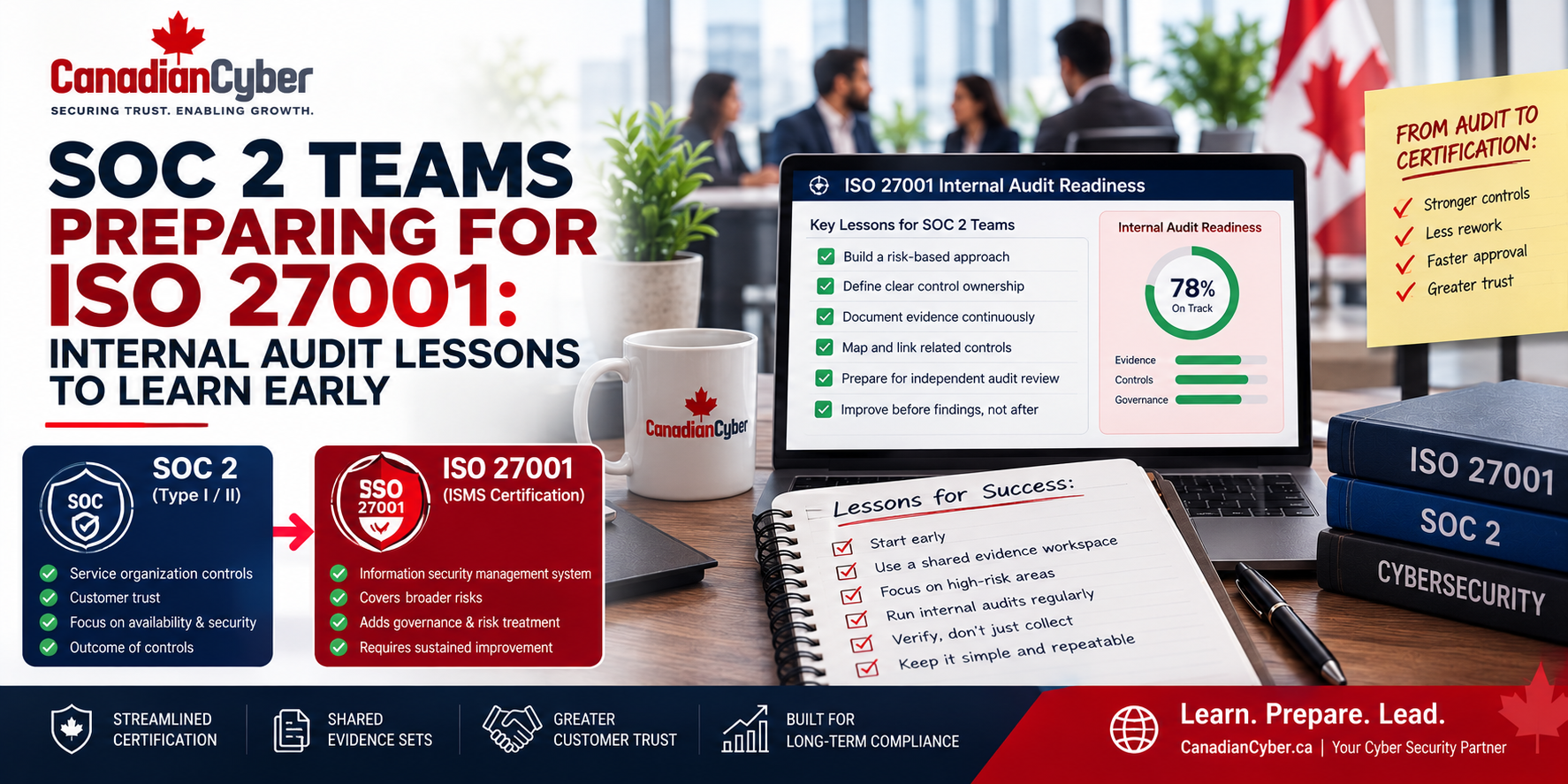
SOC 2 Teams Preparing for ISO 27001: Internal Audit Lessons to Learn Early
SOC 2 evidence can help with ISO 27001. But ISO 27001 is not simply SOC 2 with another label.
Canadian Cyber ISO 27001 Readiness for SOC 2 Teams
Turn SOC 2 Evidence Into ISO 27001 Readiness
Canadian Cyber helps SOC 2 teams prepare for ISO 27001 without starting from scratch.
We help map SOC 2 evidence to ISO 27001 clauses, Annex A controls, risk treatment, management review, internal audit, and corrective actions.
The goal is simple. Reuse what is strong, identify ISO-specific gaps, and prepare for internal audit early.
Quick Answer
SOC 2 teams preparing for ISO 27001 should learn early that ISO 27001 requires more than shared control evidence.
It requires an Information Security Management System with defined scope, organizational context, interested parties, risk assessment, risk treatment, Statement of Applicability, internal audit, management review, nonconformity handling, and continual improvement.
Practical takeaway: SOC 2 evidence can support ISO 27001. But it must be mapped, organized, explained, and supported by ISO-specific ISMS evidence.
Quick Snapshot
| Lesson | What SOC 2 Teams Should Learn Early |
|---|---|
| Management System | ISO 27001 tests the ISMS, not only control evidence. |
| Scope | The ISMS scope must be clear before evidence collection. |
| Risk Management | Controls should connect to risks and treatment actions. |
| SoA | The Statement of Applicability needs clear justification. |
| Internal Audit | Internal audit tests how the ISMS operates. |
| Management Review | Leadership decisions must be documented and evidenced. |
Why SOC 2 Teams Often Move Toward ISO 27001
Many companies start with SOC 2 because enterprise buyers ask for it first.
A customer wants a SOC 2 report. Sales needs stronger security answers. Procurement asks for evidence.
The company organizes access reviews, vendor reviews, training records, change approvals, incident response, and security policies.
Then the next customer asks whether the company is ISO 27001 certified.
SOC 2 evidence can help ISO 27001, but SOC 2 readiness alone does not automatically create an ISO 27001-ready ISMS.
Who This Blog Is For
- SOC 2 readiness teams.
- SaaS companies preparing for ISO 27001.
- Compliance managers, security leaders, CTOs, and IT managers.
- Founders selling to enterprise customers.
- vCISO teams, ISMS managers, and control owners.
- Companies with SOC 2 evidence moving toward ISO 27001.
- Microsoft 365 and SharePoint-first organizations preparing for internal audit.
Lesson 1: ISO 27001 Is a Management System, Not Only a Control Set
SOC 2 often trains teams to think in terms of controls and evidence.
That is useful. But ISO 27001 requires a full Information Security Management System.
The organization must show how information security is planned, implemented, reviewed, improved, and governed.
ISO 27001 looks for:
- ISMS scope and organizational context.
- Interested parties and leadership commitment.
- Risk assessment and risk treatment.
- Statement of Applicability and security objectives.
- Competence, awareness, and documented information.
- Operational controls and performance evaluation.
- Internal audit, management review, corrective action, and continual improvement.
Practical rule: ISO 27001 asks whether your security program is managed, not only whether your controls exist.
Lesson 2: ISO 27001 Scope Must Be Clear Before Evidence Collection
SOC 2 teams may already have a system description or audit boundary.
That helps. But ISO 27001 scope needs its own clear statement.
The ISMS scope should explain:
- what products or services are included.
- which locations, teams, and systems are included.
- which processes and data types are protected.
- which vendors support the in-scope environment.
- which exclusions apply and why.
Evidence to prepare:
- ISMS scope statement and scope approval record.
- Process map, system inventory, and asset inventory.
- Data flow diagram and vendor list.
- Organization chart and cloud architecture summary.
If scope is unclear, the internal audit will expose confusion quickly.
Lesson 3: Risk Management Is More Central in ISO 27001
SOC 2 teams may already have risk assessment evidence.
However, ISO 27001 places risk management at the centre of the ISMS.
The organization must show a defined process for identifying, assessing, treating, reviewing, and accepting information security risks.
ISO 27001 risk evidence includes:
- Risk assessment methodology and risk register.
- Risk owners, risk ratings, and risk treatment plan.
- Risk acceptance records and residual risk review.
- Risk review history and management review risk summary.
A SOC 2 control matrix is not a substitute for an ISO 27001 risk management process.
Practical rule: For ISO 27001, controls should be connected to risks, not selected only because an auditor requested them.
Lesson 4: The Statement of Applicability Is a Major ISO 27001 Document
SOC 2 teams may not be familiar with the Statement of Applicability.
For ISO 27001, the SoA is essential.
The SoA explains:
- which Annex A controls apply.
- which Annex A controls do not apply.
- why each decision was made.
- whether controls are implemented.
- how controls connect to risk treatment.
A common mistake is marking controls as implemented because similar SOC 2 evidence exists.
That is risky if the team cannot explain applicability, risk linkage, and implementation status.
The SoA should tell the story of why each control matters and how it is implemented.
Lesson 5: ISO 27001 Internal Audit Is Not Just Evidence Collection
SOC 2 readiness often involves gathering evidence for auditor requests.
ISO 27001 internal audit is broader.
It tests whether the ISMS conforms to ISO 27001 requirements and the organization’s own policies, procedures, and controls.
Internal audit should review:
- ISO 27001 clauses and Annex A controls.
- ISMS scope, risk assessment, risk treatment, and SoA.
- Policies, procedures, control operation, and evidence quality.
- Owner interviews, management review, and corrective actions.
- Continual improvement.
Practical rule: ISO 27001 internal audit tests the ISMS, not only the evidence folder.
Lesson 6: Management Review Has a Formal Role
SOC 2 teams may have leadership updates or security dashboards.
ISO 27001 requires management review as a formal ISMS activity.
This is not just a casual status meeting.
Management review should include:
- ISMS performance and risk status.
- Security objectives and internal audit results.
- Nonconformities and corrective actions.
- Incidents, monitoring results, and interested party feedback.
- Changes affecting the ISMS, opportunities for improvement, resource needs, decisions, and actions.
Evidence to prepare:
- Management review agenda and attendee list.
- Input pack, risk dashboard, and security objectives report.
- Internal audit summary and incident summary.
- Corrective action status, meeting minutes, decision log, and action tracker.
Moving From SOC 2 to ISO 27001?
Canadian Cyber helps SOC 2 teams translate existing evidence into a structured ISO 27001 ISMS evidence model.
Lesson 7: Corrective Actions Need Root Cause and Verification
SOC 2 readiness teams may be used to gap trackers.
ISO 27001 expects a stronger improvement process.
When an issue is found, document:
- what happened and why it happened.
- what immediate correction is needed.
- what corrective action will prevent recurrence.
- who owns it and when it is due.
- what evidence proves completion and who verifies closure.
Weak vs Strong Corrective Action
Weak: Update access review evidence.
Strong: Access review evidence was incomplete because the quarterly review process had no required sign-off field. Update the access review procedure, add reviewer sign-off metadata, assign the IT Manager as owner, and verify the next quarterly access review includes sign-off and exception tracking.
Lesson 8: Existing SOC 2 Evidence Can Be Reused, But It Must Be Mapped
SOC 2 evidence can be very useful for ISO 27001.
But it should be mapped correctly.
| SOC 2 Evidence | ISO 27001 Use |
|---|---|
| MFA report | Access control evidence. |
| User access review | Access control evidence. |
| Vendor risk assessment | Supplier relationship evidence. |
| Incident response tabletop | Incident management evidence. |
| Training completion report | Competence and awareness evidence. |
| Change approval ticket | Change management evidence. |
| Backup restore test | Continuity and recovery evidence. |
| Corrective action tracker | Improvement evidence. |
Mapping should include:
- SOC 2 control and ISO 27001 clause.
- Annex A control and risk reference.
- Evidence owner and evidence frequency.
- Evidence link and review status.
Collect once, map carefully, and explain differently where each framework expects different context.
Lesson 9: Control Owner Interviews Matter
SOC 2 teams may focus heavily on documents and tickets.
ISO 27001 internal auditors often interview control owners to confirm that processes are understood and followed.
Control owners should explain:
- what process they own.
- which policy applies.
- how often the control operates.
- where evidence is stored.
- what exceptions occurred.
- how issues are escalated.
- which risks relate to the control and what improvement actions are open.
Lesson 10: Evidence Quality Matters More Than Evidence Volume
A large evidence folder does not guarantee readiness.
Auditors need evidence that is relevant, current, complete, and explainable.
Strong evidence shows:
- date, owner, system, or process.
- control period, approval, and review result.
- exceptions, follow-up, and closure evidence.
- control mapping.
Weak evidence includes:
- undated screenshots and unapproved policy drafts.
- access exports with no sign-off.
- vendor files with no review notes.
- training reports with missing users.
- corrective actions with no verification.
Practical rule: A small amount of strong evidence is better than a large folder of unclear files.
Lesson 11: ISO 27001 Requires Internal Audit Independence
Internal audit should be objective.
The person auditing a process should not be the same person responsible for operating that process.
For smaller organizations, independence can be challenging. Still, it needs to be considered.
Internal audit planning should define:
- audit scope, audit criteria, and auditor role.
- audit schedule and areas audited.
- sampling approach and interview plan.
- evidence reviewed, findings method, and follow-up process.
Lesson 12: SOC 2 Type II Evidence Helps, But ISO 27001 Still Needs ISMS Proof
If a company has SOC 2 Type II evidence, that is useful.
It may show controls operating over time.
But ISO 27001 still requires ISMS-specific proof.
ISO 27001-specific evidence still needed:
- ISMS scope and context of the organization.
- Interested parties register and risk assessment methodology.
- Risk register and risk treatment plan.
- Statement of Applicability and security objectives.
- Internal audit program and internal audit report.
- Management review minutes, nonconformity records, corrective actions, and continual improvement evidence.
SOC 2 Type II evidence can support ISO 27001, but it does not replace the ISMS.
Internal Audit Lessons Checklist for SOC 2 Teams
| Readiness Lesson | Ready? |
|---|---|
| We understand ISO 27001 is a management system. | |
| ISMS scope is clearly defined. | |
| Risk methodology is documented. | |
| Risk register is current and owned. | |
| Risk treatment plan is tracked. | |
| Statement of Applicability is justified. | |
| SOC 2 evidence is mapped to ISO 27001 clauses and controls. | |
| Internal audit plan is prepared. | |
| Auditor independence is considered. | |
| Control owners are ready for interviews. | |
| Management review is planned and documented. | |
| Corrective action process includes root cause. | |
| Closure evidence is verified. | |
| Evidence is stored in one controlled workspace. | |
| ISO-specific evidence gaps are identified early. |
Common Mistakes SOC 2 Teams Make When Moving to ISO 27001
- Assuming SOC 2 evidence automatically equals ISO 27001 readiness. Shared evidence helps, but ISO 27001 has additional ISMS requirements.
- Building the SoA too late. The Statement of Applicability should be developed early and linked to risk treatment.
- Treating internal audit like a checklist. Internal audit should test how the ISMS operates.
- Skipping management review preparation. Management review is a formal ISO 27001 requirement.
- Using weak root cause analysis. Corrective actions should prevent recurrence, not only close tasks.
- Not preparing control owners. Owners should be ready to explain their processes.
- Storing evidence by framework instead of control. This creates duplicate work and inconsistent evidence.
- Skipping ISO-specific evidence gap review. SOC 2 evidence should be reviewed against ISO 27001 requirements early.
How SharePoint Can Help SOC 2 Teams Prepare for ISO 27001
A structured SharePoint ISMS can help teams reuse SOC 2 evidence while preparing ISO 27001-specific records.
It helps reduce duplication and gives teams one controlled workspace for evidence, owners, gaps, and audit views.
Canadian Cyber’s ISMS SharePoint Solution can organize:
- Shared evidence library and SOC 2 control register.
- ISO 27001 control register and risk register.
- Statement of Applicability tracker and policy library.
- Vendor register and access review tracker.
- Incident register, change evidence, training evidence, and backup evidence.
- Internal audit workspace and management review dashboard.
- Corrective action tracker, audit request tracker, client-ready evidence room, Power Automate reminders, and Teams notifications.
SharePoint works best when evidence is mapped across frameworks, not duplicated into separate folders.
How Canadian Cyber Helps
Canadian Cyber helps SOC 2 teams prepare for ISO 27001 without starting from scratch.
We help organizations reuse strong SOC 2 evidence, identify ISO-specific gaps, build the ISMS structure, prepare internal audit evidence, and organize everything in a controlled workspace.
Canadian Cyber can support:
- ISO 27001 readiness reviews for SOC 2 teams.
- SOC 2 to ISO 27001 evidence mapping.
- ISO 27001 implementation and internal audits.
- Risk register development and SoA review.
- Internal audit planning and management review preparation.
- Corrective action verification and control owner interview preparation.
- SharePoint ISMS implementation and SOC 2 readiness assessments.
- vCISO services, cybersecurity assessments, ISO 27017, ISO 27018, and ISO 42001 support.
Frequently Asked Questions
Can SOC 2 evidence support ISO 27001?
Yes. SOC 2 evidence such as access reviews, vendor assessments, training records, incident response evidence, change approvals, backup tests, and monitoring records can support ISO 27001 when mapped properly.
Is ISO 27001 the same as SOC 2?
No. ISO 27001 is a management system standard built around an ISMS, risk management, internal audit, management review, and continual improvement. SOC 2 is an assurance report based on Trust Services Criteria and service commitments.
What should SOC 2 teams prepare first for ISO 27001?
SOC 2 teams should prepare ISMS scope, risk methodology, risk register, risk treatment plan, Statement of Applicability, internal audit plan, management review process, and corrective action process.
Why is internal audit important for ISO 27001?
Internal audit tests whether the ISMS conforms to ISO 27001 requirements and the organization’s own policies and controls. It helps identify gaps before certification audit.
Can SOC 2 Type II replace ISO 27001 internal audit?
No. SOC 2 Type II evidence can help, but ISO 27001 still requires its own internal audit process and ISMS-specific evidence.
Can Canadian Cyber help SOC 2 teams prepare for ISO 27001?
Yes. Canadian Cyber helps SOC 2 teams map evidence to ISO 27001, build the ISMS, prepare internal audit evidence, review the SoA, conduct internal audits, and implement SharePoint ISMS workspaces.
Takeaway
SOC 2 teams have a strong starting point for ISO 27001.
They already understand controls, evidence, access reviews, vendors, incidents, change management, training, and audit requests.
But ISO 27001 adds a wider management system layer.
To prepare well, SOC 2 teams should learn early that ISO 27001 requires scope, risk methodology, risk treatment, SoA, internal audit, management review, root-cause corrective actions, owner readiness, and continual improvement.
The best time to learn these lessons is before the internal audit begins.
Is Your SOC 2 Team Preparing for ISO 27001?
Canadian Cyber can help you avoid duplicate work and build a practical ISMS evidence model.
We support SOC 2 to ISO 27001 evidence mapping, ISO 27001 readiness reviews, ISO 27001 implementation, ISO 27001 internal audits, management review preparation, corrective action verification, vCISO services, cybersecurity assessments, SOC 2 readiness, ISO 27017, ISO 27018, ISO 42001 AI governance, and SharePoint ISMS implementation. You can also learn more through Waqar Mehboob’s profile.
Stay Connected With Canadian Cyber
Follow Canadian Cyber for practical guidance on SOC 2, ISO 27001, internal audits, ISMS evidence, compliance mapping, SharePoint ISMS, ISO 42001, ISO 27017, ISO 27018, cybersecurity assessments, and vCISO support.