Get in touch
info@canadiancyber.ca


Rafia Rizwan

February 26, 2026
Microsoft 365 compliance tools can support ISO 27001, SOC 2, and privacy governance if configured correctly. Learn which hidden features you’re already paying for.
Microsoft 365 • ISO 27001 • SOC 2 • Privacy
The built-in tools you’re already paying for (but probably not using) and how to turn them into audit-ready governance without buying another platform.
Most organizations chasing ISO 27001 or SOC 2 assume they need a new GRC tool.
If you’re using Microsoft 365, you already own powerful compliance capabilities they’re just hidden, underused, or misconfigured.
Many Canadian organizations already pay for Microsoft 365 Business Premium or E3/E5, pursue ISO 27001 or SOC 2, and still struggle with documentation, monitoring, and evidence collection.
Compliance doesn’t always require more tools. It requires better use of what you already have and a governance structure that makes those tools audit-ready.
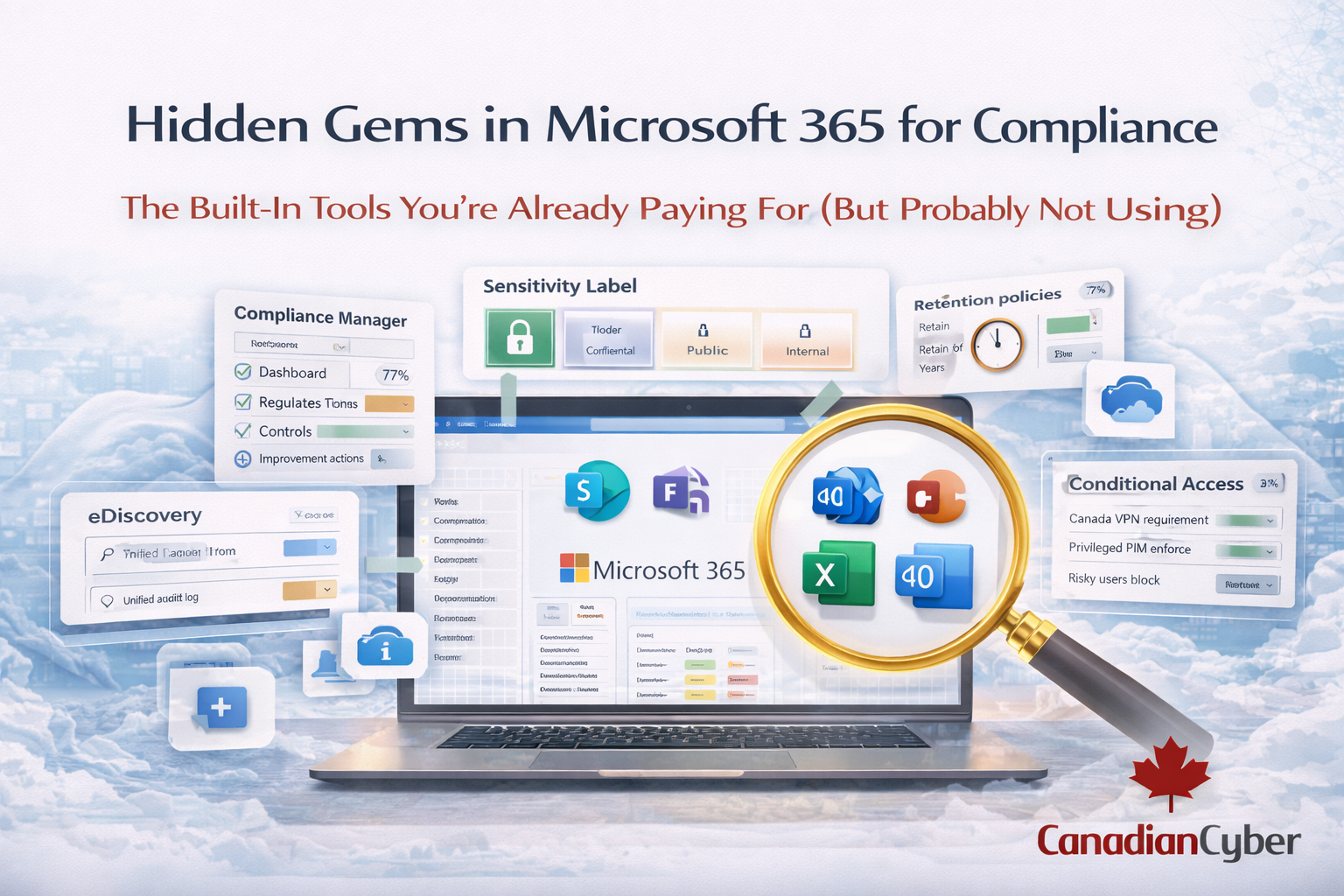
Most teams have never opened it. But Purview Compliance Manager can help you track posture, map requirements, and assign improvement actions.
It’s not a full ISMS by itself but it becomes extremely useful when configured and tied to ownership.
Reality check: If it’s not configured, assigned, and reviewed on cadence, it becomes another “nice dashboard” with no audit value.
ISO 27001 requires information classification and handling controls. Privacy regulations require protection of personal information.
Sensitivity labels help you classify data and enforce rules automatically but only if deployed properly.
Common pitfall: Labels exist but are optional. If nobody uses them (or they don’t enforce anything), auditors won’t count it as a control.
Retention governance is essential for privacy compliance, legal defensibility, and data minimization.
Manual deletion is inconsistent. Retention policies make your data lifecycle defensible and repeatable.
Audit note: Retention policies become much stronger when paired with documented rationale, ownership, and periodic review.
If an incident happens, can you prove who accessed sensitive files, what changed, and when?
Microsoft 365 includes investigation and audit capabilities that support incident response evidence and monitoring controls.
Reminder: Monitoring without review is not a control it’s a checkbox. Auditors look for proof of review.
Identity remains the #1 attack vector. Microsoft 365 identity controls (MFA, conditional access, privileged controls, access reviews)
directly support ISO 27001 and SOC 2 security criteria and reduce real breach probability.
A practical, audit-focused checklist you can use to uncover M365 features you already own and turn them into defensible evidence for ISO 27001 or SOC 2.
Get the checklist
Microsoft 365 tools alone do not equal compliance. Without structure, you still face unclear ownership, inconsistent monitoring,
missing documentation, and audit panic.
Auditors don’t audit intentions they audit proof. The real win comes from embedding Microsoft 365 capabilities inside a governance framework: assigned owners, review cadence, evidence storage, and consistent control testing.
| Compliance need | Common mistake | Better approach |
|---|---|---|
| Data classification | Labels exist but optional | Enforced labels + documented handling rules |
| Retention / minimization | Manual deletion and inconsistent retention | Retention policies + scheduled review evidence |
| Access governance | MFA on admins only; reviews not logged | Conditional access + automated access reviews |
| Monitoring | Audit logs enabled, never reviewed | Defined review cadence + review records stored centrally |
We’ll help you identify which compliance features you already own, what’s underconfigured, and how to align Microsoft 365 with ISO 27001, SOC 2, or privacy requirements without buying another platform.
Prefer email? Request the checklist + a practical roadmap for your tenant setup:
Ask for the M365 Compliance Roadmap
Follow us for compliance automation insights and Microsoft 365 governance strategies: