Get in touch
info@canadiancyber.ca


Rafia Rizwan

April 15, 2026
Learn how to use a SharePoint compliance portal to manage ISO 27001, SOC 2, and privacy work in one structured, audit-ready system.
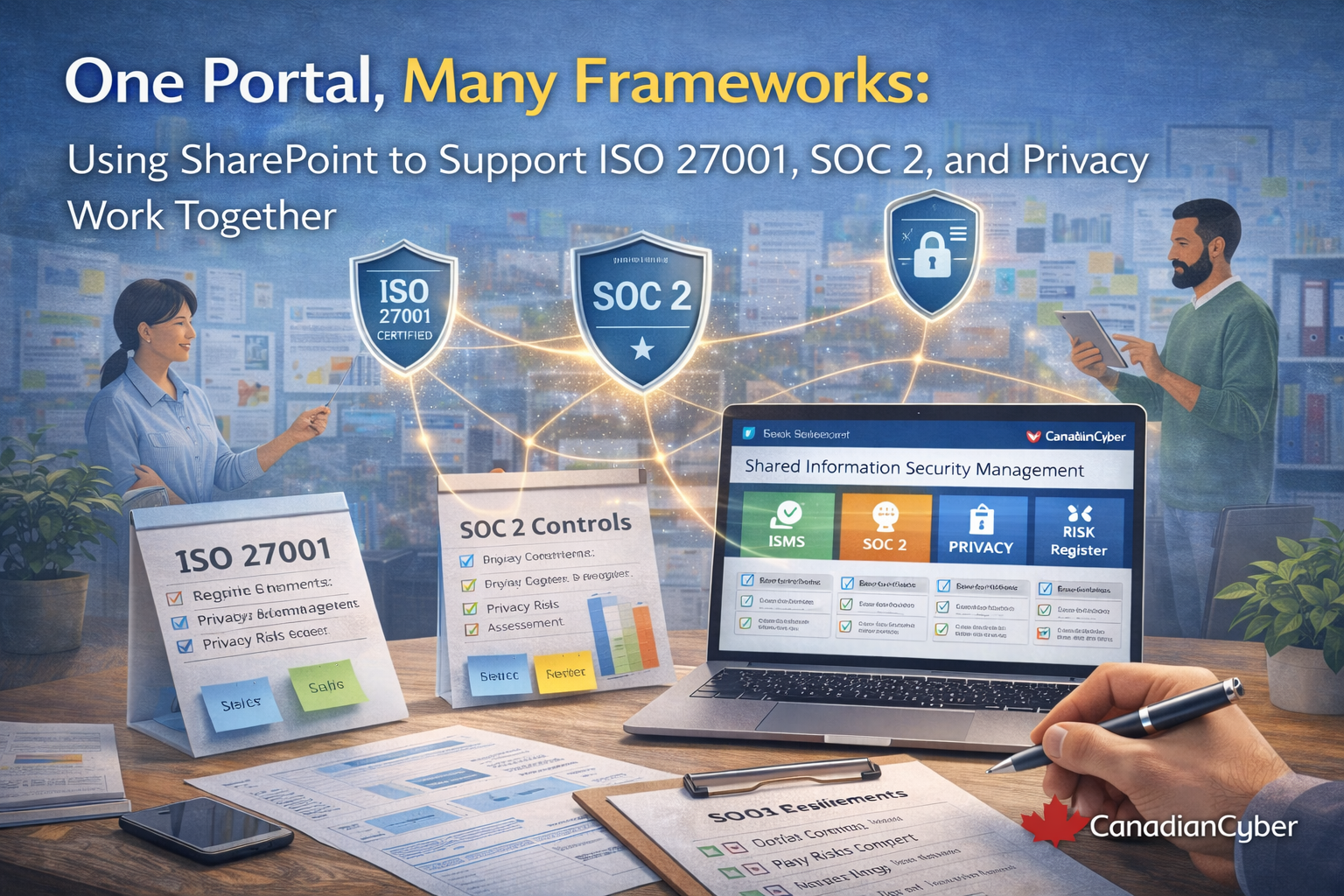
The ISO 27001 documents live in one place. SOC 2 evidence sits across shared drives and screenshots. Privacy records are stored somewhere else. Corrective actions live in spreadsheets. Risk updates happen in meetings and then disappear into email threads.
Individually, each effort may be moving forward. Together, they often feel disconnected, repetitive, and harder to govern than they should be.
This is where a well-structured SharePoint portal can make a major difference. Instead of managing separate compliance worlds, organizations can run one central governance environment where security, compliance, and privacy work support each other.
At first, many organizations treat each framework as a separate project. That feels reasonable. ISO 27001 has its own clauses, policies, risks, and audit expectations. SOC 2 has its own criteria, evidence cycles, and reporting needs. Privacy work brings retention rules, processor reviews, data handling obligations, and regulatory duties.
But in real operations, these areas overlap constantly.
The real problem is not that the work is different. The problem is that teams document and manage overlapping work in disconnected ways.
Many organizations already use Microsoft 365, which makes SharePoint a practical operational choice rather than a new platform decision. When structured properly, it can become one workspace where related governance activities are organized, linked, and reused cleanly.
| SharePoint capability | Why it helps multi-framework work |
|---|---|
| Central document libraries | Keeps policies, procedures, and records in one controlled place. |
| Structured lists | Supports risks, vendors, findings, actions, assets, and privacy records. |
| Version history and approvals | Makes policy control and evidence governance much cleaner. |
| Permissions and filtered views | Lets different teams see the same system in different ways without duplicating it. |
| Dashboards and reporting pages | Helps leadership understand program health across frameworks. |
That is a much better model than building separate silos for each framework.
Picture a growing SaaS company preparing for ISO 27001 certification, responding to SOC 2 customer requests, and handling increasing privacy obligations around personal data.
The compliance lead is dealing with ISO policies in SharePoint, SOC 2 evidence in a shared drive, vendor reviews in Excel, privacy notes in Word documents, incident logs in a ticketing tool, and corrective actions inside email threads.
Every time someone asks for evidence, the team starts hunting. Every framework review feels like a separate exercise. Every audit cycle creates the same questions again.
This is exactly where a SharePoint portal changes the experience. Instead of running three parallel compliance worlds, the organization can build one structured governance environment that supports them all.
ISO 27001, SOC 2, and privacy programs are not identical. But they do share a large common foundation. The goal is not to force them into identical language. The goal is to build one portal where shared governance activities can be reused, linked, and tracked cleanly.
| Shared governance element | Why it supports multiple frameworks |
|---|---|
| Policies and procedures | Needed across ISO 27001, SOC 2, and privacy operations. |
| Risk tracking | Supports security risk, supplier risk, and privacy-related risk. |
| Corrective actions | Useful after audits, incidents, reviews, assessments, and management decisions. |
| Evidence management | Supports certification, attestations, privacy accountability, and customer due diligence. |
| Vendor oversight | Relevant for ISO supplier controls, SOC 2 oversight, and privacy obligations. |
| Incident records | Important for security events, privacy breach readiness, and management review. |
A central policy and procedure library becomes the controlled source for information security policy, access control, supplier governance, incident response, retention, privacy-related procedures, and related operational documents.
| Document | Supports |
|---|---|
| Access Control Policy | ISO 27001, SOC 2, Privacy |
| Incident Response Plan | ISO 27001, SOC 2, Privacy breach readiness |
| Supplier Security Procedure | ISO 27001, SOC 2, Privacy vendor due diligence |
| Data Retention Procedure | Privacy, ISO governance, SOC 2 evidence support |
Instead of duplicating policies for each framework, one approved version can be stored once and mapped to all relevant uses.
A central SharePoint risk register can support information security risks, vendor risks, privacy-related risks, and audit-linked remediation concerns inside one system.
That allows security teams, privacy teams, and leadership to view the same underlying register through different filters instead of maintaining isolated spreadsheets.
Corrective actions are one of the easiest places to unify effort. A single SharePoint corrective action list can manage findings from ISO internal audits, SOC 2 reviews, privacy assessments, incidents, penetration tests, vendor reviews, and management review decisions.
A structured SharePoint evidence library can reduce repeated evidence collection by storing reusable records once and mapping them to more than one framework.
Vendor governance is one of the biggest overlap points across ISO 27001, SOC 2, and privacy. A structured vendor register can track service details, data sensitivity, access, criticality, security review dates, privacy impact, contract status, and evidence collected.
Privacy work often gets separated too early, even though it relies on many of the same controls and governance workflows. A strong portal can include dedicated privacy areas for personal data inventories, processing records, retention schedules, impact assessments, breach decision logs, and data subject request tracking while still connecting them to vendors, policies, incidents, and risk reviews.
A mature multi-framework SharePoint portal often gives different teams different views into the same underlying structure instead of giving every team separate systems.
| Team view | Typical focus |
|---|---|
| Security team | control evidence, incidents, risk items, technical reviews, corrective actions |
| Compliance team | audit schedule, evidence status, policy reviews, framework mapping, open findings |
| Privacy team | processing records, vendor and processor details, retention items, privacy reviews, request logs |
| Leadership | high risks, overdue actions, major findings, policy status, critical vendor reviews, top privacy concerns |
This keeps the portal unified without making every user see everything.
SharePoint can support multi-framework work very well, but only if it is designed intentionally. A messy SharePoint setup can easily become just another storage problem.
Many organizations are already doing the hard work across ISO 27001, SOC 2, and privacy obligations. What creates unnecessary strain is that the work lives in disconnected systems.
In most cases, the smarter approach is not to build separate compliance worlds. It is to build one structured SharePoint portal where shared governance activities can support multiple frameworks at once.
That does not mean everything becomes identical. It means the underlying processes such as policy control, risk tracking, evidence management, corrective actions, vendor oversight, privacy records, and reporting are organized in one place with enough structure to serve many needs.
ISO 27001, SOC 2, and privacy work may use different language and produce different outputs, but much of the real work behind them overlaps.
That is why one SharePoint portal can be such a practical solution. When designed well, it allows organizations to manage policies once, reuse evidence intelligently, connect risks and corrective actions, align security and privacy work, reduce duplication, improve audit readiness, and give leadership a clearer picture of governance health.
In the end, the goal is not just to organize files. It is to create one portal where governance work actually works together.