SOC 2 • Fintech APIs • API Security • Availability • Processing Integrity
SOC 2 Implementation for Fintech APIs: Security, Availability, and Processing Integrity Controls
Fintech APIs need more than basic security documentation. When payments, account workflows, integrations, financial data, and transaction events move through APIs, SOC 2 implementation must prove that the environment is secure, available, monitored, and processing data correctly.
Quick Snapshot
| SOC 2 Area | Why It Matters for Fintech APIs |
|---|---|
| Security | Protects APIs, tokens, customer data, admin access, integrations, and production systems. |
| Availability | Shows the fintech API can stay reliable, monitored, backed up, and recoverable. |
| Processing Integrity | Proves API transactions are complete, accurate, timely, authorized, and traceable. |
| Evidence | Supports buyers, auditors, partners, banks, investors, and security questionnaires. |
| Business Outcome | Helps fintech teams reduce procurement friction and build stronger trust with enterprise buyers. |
Introduction
Fintech companies run on trust.
A fintech API may support:
Account verification
Transaction routing
Banking integrations
Ledger updates
Customer onboarding
Identity checks
Compliance workflows
If the API is insecure, customers worry about data exposure. If the API is unreliable, customers worry about downtime. If the API processes data incorrectly, customers worry about financial loss, failed transactions, reporting errors, or broken workflows.
A generic SOC 2 checklist is not enough for fintech APIs. Teams need controls and evidence that show the API is protected, monitored, tested, reviewed, and processing data correctly.
This blog explains how fintech API companies can approach SOC 2 implementation across three important Trust Services Criteria: Security, Availability, and Processing Integrity.
Need SOC 2 for a Fintech API?
Canadian Cyber helps fintech and SaaS companies prepare for SOC 2 with API security evidence, access control reviews, vendor risk management, incident response, backup recovery, processing integrity controls, SharePoint evidence workspaces, and vCISO support.
Why SOC 2 Matters for Fintech APIs
Fintech APIs often sit inside high-trust workflows. They connect platforms, customers, financial institutions, merchants, applications, and internal systems. That makes buyers ask detailed questions before they approve the vendor relationship.
| Buyer Question | What They Want to Know |
|---|---|
| How do you secure API access? | Authentication, authorization, and token controls. |
| How do you prevent unauthorized transactions? | Approval, validation, and access controls. |
| How do you monitor uptime? | Availability monitoring and incident response. |
| How do you detect API abuse? | Rate limits, alerts, and anomaly detection. |
| How do you protect financial data? | Encryption, access control, and logging. |
| How do you prove changes are reviewed? | Change management and deployment evidence. |
| How do you test recovery? | Backups, failover, and restore tests. |
| How do you ensure transaction accuracy? | Processing integrity checks and reconciliations. |
Practical rule: For fintech APIs, SOC 2 should prove that security, reliability, and transaction integrity are built into operations.
SOC 2 Criteria That Matter Most for Fintech APIs
Most SOC 2 projects include Security. For fintech APIs, Availability and Processing Integrity may also be important depending on customer commitments and product function.
| Criterion | Relevance to Fintech APIs |
|---|---|
| Security | Core for all SOC 2 reports. Protects systems and data from unauthorized access. |
| Availability | Important when customers rely on API uptime and service reliability. |
| Processing Integrity | Important when API processing must be complete, valid, accurate, timely, and authorized. |
| Confidentiality | Relevant if sensitive financial or business data is protected under commitments. |
| Privacy | Relevant if personal information is collected, processed, or retained. |
Practical rule: Do not select criteria only because they sound impressive. Select criteria based on customer commitments, product risk, and buyer expectations.
Security Controls for Fintech APIs
Security is the foundation of SOC 2. For fintech APIs, security controls must cover users, systems, tokens, service accounts, vendors, cloud infrastructure, production changes, and sensitive data.
API Authentication and Authorization
| Control Question | Evidence |
|---|---|
| Are APIs protected with strong authentication? | API authentication standard. |
| Are API keys or tokens unique per client? | Token management records. |
| Are scopes and permissions defined? | API scope matrix. |
| Can tokens be revoked? | Revocation procedure. |
| Are expired or unused tokens reviewed? | Token review evidence. |
| Are privileged API actions restricted? | Admin endpoint control list. |
Common mistakes include:
- using long-lived API keys with no rotation
- giving clients broad scopes by default
- having no token revocation process
- not reviewing inactive integrations
- weak separation between test and production tokens
- admin endpoints not separately protected
Practical rule: Every fintech API token should have an owner, purpose, scope, and lifecycle.
Access Control for Production Systems
SOC 2 buyers and auditors care deeply about who can access production. Review access to:
Database admin access
API gateway access
CI/CD access
Source code access
Secrets managers
Production logs
Customer support dashboards
| Evidence to Collect | Why It Helps |
|---|---|
| MFA report | Shows admin access is protected. |
| Privileged access review | Proves production access is reviewed. |
| Admin role export | Shows who has elevated access. |
| Offboarding samples | Shows access is removed when users leave. |
| Service account register | Documents non-human access. |
| Access exception register | Tracks approved access exceptions. |
API Abuse and Rate Limiting Controls
Fintech APIs may be targeted for abuse, fraud, scraping, credential attacks, or transaction manipulation. API availability and security both depend on abuse controls.
| Control | Evidence |
|---|---|
| Rate limits | API gateway configuration. |
| Abuse alerts | Alert rules and ticket samples. |
| Anomaly monitoring | Monitoring dashboard or detection logic. |
| IP or client throttling | Gateway rules. |
| Failed authentication monitoring | Log review evidence. |
| Fraud or misuse escalation | Incident runbook. |
Secure Development and Change Management
Fintech API changes can affect security, availability, and processing integrity. A small code change can impact transaction handling, data mapping, validation logic, or partner integrations.
| Change Management Evidence | Purpose |
|---|---|
| Pull request approvals | Shows changes are reviewed. |
| Ticket or change record | Shows business and technical context. |
| Test results | Shows validation before release. |
| Deployment log | Shows what changed and when. |
| Rollback plan | Shows recovery planning. |
| Emergency change record | Shows urgent changes are controlled. |
Practical rule: For fintech APIs, change evidence should show not only that code was reviewed, but that processing impact was considered.
Secrets and Key Management
Fintech APIs often rely on API keys, webhook secrets, database credentials, cloud access keys, encryption keys, payment processor credentials, and banking integration tokens.
| Key Management Control | Evidence |
|---|---|
| Secrets stored in approved vault | Vault configuration. |
| Access to secrets restricted | Access review. |
| Key rotation process | Rotation records. |
| Secrets not stored in code | Repository scan evidence. |
| Environment separation | Dev/test/prod config evidence. |
| Emergency revocation process | Incident runbook. |
Practical rule: Secrets should not live in code, tickets, spreadsheets, or chat messages.
Strengthen API Security Evidence Before SOC 2
Canadian Cyber helps fintech teams organize API authentication standards, token lifecycle evidence, privileged access reviews, secrets management proof, rate limiting evidence, and change management samples.
Availability Controls for Fintech APIs
Availability matters when clients rely on the API for business operations. If API downtime affects payments, onboarding, reporting, account checks, or customer workflows, Availability may be relevant for SOC 2.
| Availability Control Area | Why It Matters |
|---|---|
| Uptime Monitoring | Detects outages quickly. |
| Incident Response | Coordinates response and communication. |
| Backup and Recovery | Supports restoration. |
| Capacity Management | Reduces performance failure. |
| Dependency Monitoring | Tracks vendors and integrations. |
| Post-Incident Review | Improves resilience. |
Uptime Monitoring and Alerting
Fintech API teams should monitor both technical and customer-impacting signals.
API latency
Error rates
Authentication failures
Transaction failure rates
Webhook delivery failures
Queue backlogs
Third-party dependency status
| Evidence to Collect | Purpose |
|---|---|
| Monitoring configuration | Shows what is monitored. |
| Alert rules | Shows how issues are detected. |
| On-call schedule | Shows response ownership. |
| Incident tickets | Shows response tracking. |
| Uptime reports | Shows service reliability. |
| Post-incident reviews | Shows improvement actions. |
Practical rule: Monitoring should track what customers actually rely on, not only server health.
Backup, Recovery, and Resilience
| Recovery Question | Evidence |
|---|---|
| Are critical systems backed up? | Backup configuration. |
| Are backups monitored? | Backup reports. |
| Are restore tests completed? | Restore test evidence. |
| Are recovery objectives defined? | RTO / RPO documentation. |
| Are dependencies identified? | System dependency map. |
| Are recovery issues tracked? | Corrective action register. |
Backup evidence proves backups run. Restore evidence proves recovery has been tested.
Dependency and Vendor Availability
Fintech APIs often depend on cloud providers, payment processors, banking data providers, identity verification vendors, fraud detection platforms, API gateway providers, KYC vendors, monitoring tools, and data platforms.
| Vendor Availability Question | Why It Matters |
|---|---|
| Which vendors are critical to service delivery? | Defines dependency risk. |
| Do vendors have uptime commitments? | Supports availability planning. |
| Are vendor incidents monitored? | Helps response. |
| Are alternative processes documented? | Reduces business disruption. |
| Are vendor reviews completed? | Supports SOC 2 evidence. |
| Are incident contacts known? | Speeds escalation. |
Practical rule: Availability is not only your infrastructure. It also depends on critical vendors.
Processing Integrity Controls for Fintech APIs
Processing Integrity is especially important for fintech APIs when transactions, calculations, routing, reporting, or financial workflows must be complete, accurate, valid, timely, and authorized.
For fintech APIs, processing integrity may involve:
- validating request data
- rejecting malformed transactions
- preventing duplicate processing
- ensuring transaction status accuracy
- logging transaction events
- reconciling processed records
- handling retries correctly
- ensuring webhooks are delivered accurately
- monitoring processing errors
Processing integrity asks: did the system process the right data, in the right way, at the right time, with the right authorization?
Input Validation Controls
| Validation Area | Control Example |
|---|---|
| Required fields | Reject missing data. |
| Data format | Validate dates, amounts, and identifiers. |
| Authorization | Confirm client can perform requested action. |
| Limits | Enforce transaction limits. |
| Duplicate checks | Prevent duplicate transaction submission. |
| Integrity checks | Verify signatures, hashes, or payload authenticity. |
Evidence to collect:
Test cases
Error handling documentation
Rejected transaction samples
Automated test results
Authorization test evidence
Transaction Logging and Traceability
Fintech processing needs traceability. A transaction should be easy to investigate.
| Transaction Traceability Field | Why It Helps |
|---|---|
| Transaction ID | Unique transaction reference. |
| Client ID | Shows which client submitted the request. |
| Timestamp | Shows when activity occurred. |
| Authorization decision | Shows whether the action was permitted. |
| Processing status | Shows completed, failed, retried, or pending. |
| Error code | Supports investigation. |
| Retry count | Shows retry handling. |
| Webhook delivery status | Shows integration notification status. |
Practical rule: If a customer disputes a transaction status, your team should be able to trace what happened.
Reconciliation and Error Handling
Processing integrity needs checks. Fintech APIs should detect when expected processing does not match actual results.
| Process | Reconciliation Check |
|---|---|
| Payment event | Compare API status to processor status. |
| Ledger update | Confirm transaction posted once. |
| Webhook delivery | Confirm delivery or retry status. |
| Account verification | Confirm response matches provider result. |
| Batch job | Confirm record count and error count. |
| Data sync | Confirm records processed successfully. |
Error handling evidence can include:
- failed job reports
- exception queue review
- reconciliation logs
- manual review records
- client notification records
- corrective action tickets
- root cause analysis
Webhook and Integration Integrity
| Webhook Control | Evidence |
|---|---|
| Signed webhooks | Signing standard. |
| Secret rotation | Rotation record. |
| Retry logic | Retry configuration. |
| Delivery logging | Delivery logs. |
| Failure alerts | Alert rules. |
| Replay protection | Timestamp or nonce validation. |
Practical rule: Webhooks are part of your control environment. Do not treat them as afterthoughts.
Build Processing Integrity Controls Before Audit
Canadian Cyber helps fintech API teams document input validation, transaction traceability, reconciliation checks, webhook controls, retry logic, error handling, and processing exception evidence.
SOC 2 Evidence Pack for Fintech APIs
A strong evidence pack saves time during audit and buyer review.
Security Evidence
- MFA report
- Privileged access review
- API token review
- API scope matrix
- Secrets vault configuration
- Change approval samples
Availability Evidence
- Uptime reports
- Monitoring configuration
- Alert rules
- Incident tickets
- Backup reports
- Restore test evidence
Processing Integrity Evidence
- API validation tests
- Transaction trace samples
- Reconciliation reports
- Failed job review
- Webhook delivery logs
- Processing exception tracker
Build My Fintech API SOC 2 Evidence Pack
Canadian Cyber helps fintech API teams build SOC 2 evidence packs that support Security, Availability, Processing Integrity, and enterprise buyer reviews.
SharePoint Evidence Workspace for SOC 2
Fintech SOC 2 evidence should not live in email or random folders. A structured SharePoint workspace can help organize evidence, owners, review status, audit requests, risk items, and leadership reporting.
| Recommended Library | Purpose |
|---|---|
| Access Control Evidence | MFA, admin review, offboarding. |
| API Security Evidence | Tokens, scopes, abuse controls. |
| Availability Evidence | Uptime, alerts, recovery. |
| Processing Integrity Evidence | Validation, reconciliation, transaction logs. |
| Vendor Evidence | Vendor reviews and assurance reports. |
| Change Evidence | PRs, approvals, releases. |
| Risk Register | API, fintech, vendor, and processing risks. |
| Audit Request Tracker | Auditor and buyer evidence requests. |
Useful metadata includes:
Trust Services Criteria
Evidence owner
Period covered
Source system
Review status
Related risk
Sensitivity
Explore the ISMS SharePoint Solution
Canadian Cyber’s ISMS SharePoint solution helps fintech and SaaS teams manage SOC 2 evidence, API risks, vendor reviews, policies, audit requests, corrective actions, and leadership reviews in one Microsoft 365 workspace.
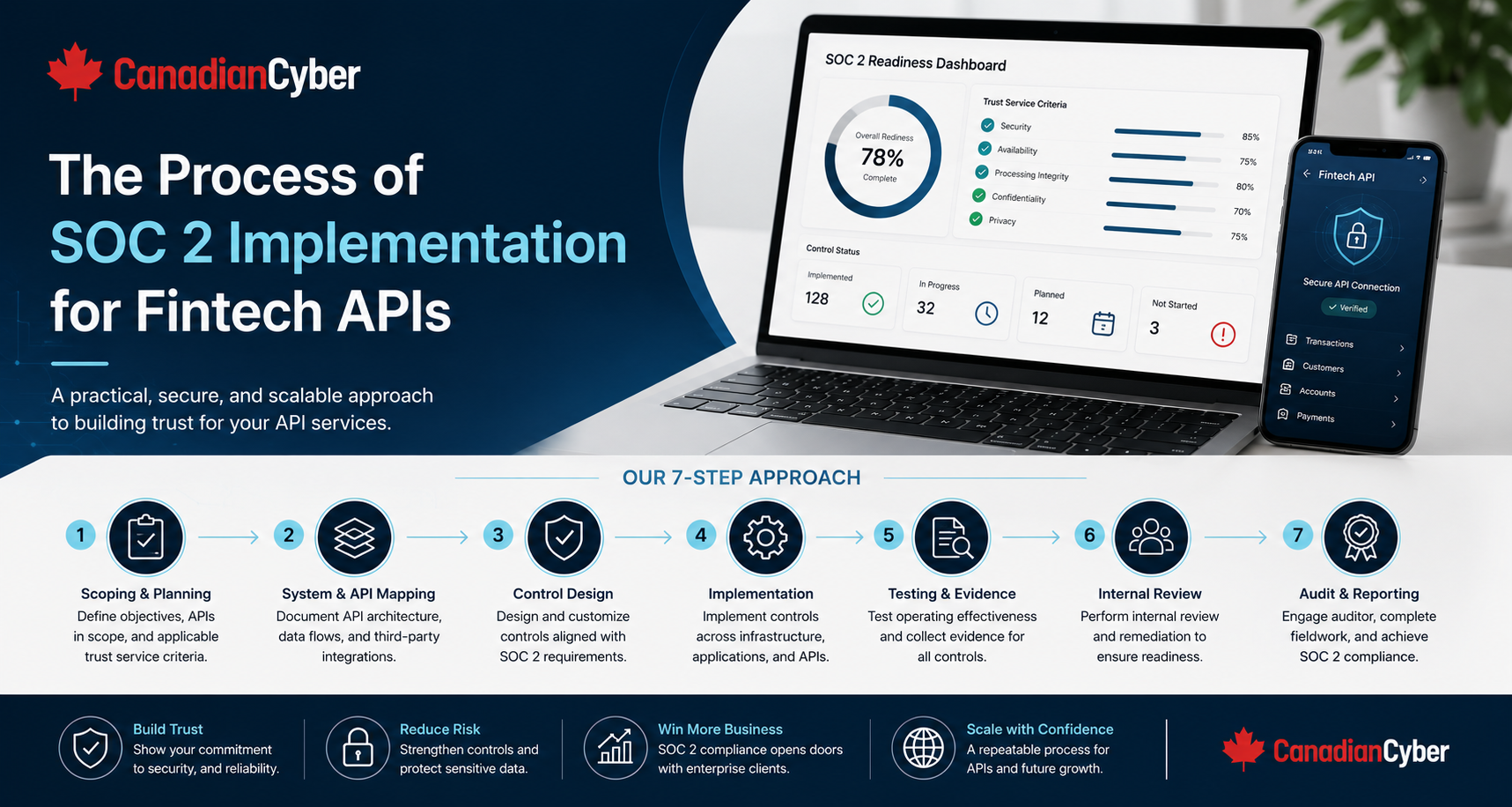
Fintech API SOC 2 Implementation Timeline
| Phase | Focus |
|---|---|
| Phase 1: Scope and Readiness | Define product scope, API services, customer data, Trust Services Criteria, vendors, owners, and evidence workspace. |
| Phase 2: Control Design | Document API authentication, token lifecycle, access control, monitoring, backup recovery, processing checks, vendor risk, and policies. |
| Phase 3: Evidence Collection | Collect MFA evidence, access review, API token review, uptime reports, restore tests, reconciliation evidence, change samples, and vendor evidence. |
| Phase 4: Gap Closure | Fix access gaps, improve monitoring, document retry logic, formalize reconciliation, review webhook controls, complete tabletop, and close high-risk actions. |
| Phase 5: Audit and Buyer Readiness | Prepare evidence index, trust summary, questionnaire answers, auditor handoff, leadership briefing, and ongoing evidence cadence. |
Common Mistakes to Avoid
- Treating API security as only authentication. Authorization, scopes, rate limits, token lifecycle, logging, and abuse detection matter too.
- Ignoring Processing Integrity. Fintech APIs need to prove that transactions and workflows are processed correctly.
- No token review. API keys and service accounts should be reviewed like privileged access.
- No reconciliation evidence. Processing claims need proof.
- Monitoring only infrastructure. Monitor API outcomes, error rates, transaction failures, webhook failures, and dependency issues.
- No vendor dependency map. Payment processors, KYC vendors, cloud providers, and banking data partners may affect availability and processing.
- Evidence scattered across tools. Use SharePoint or a structured evidence workspace.
Fintech API SOC 2 Readiness Checklist
Use this checklist before starting your SOC 2 audit.
Security
| Question | Yes / No |
|---|---|
| Is API authentication documented? | |
| Are API scopes defined? | |
| Are API tokens reviewed? | |
| Can tokens be revoked? | |
| Is MFA enforced for admin access? | |
| Are privileged users reviewed? | |
| Are secrets stored in a vault? | |
| Are changes reviewed before production? |
Availability
| Question | Yes / No |
|---|---|
| Is API uptime monitored? | |
| Are latency and error rates monitored? | |
| Are alerts reviewed? | |
| Are incidents tracked? | |
| Are backups monitored? | |
| Are restore tests documented? | |
| Are critical vendors identified? |
Processing Integrity
| Question | Yes / No |
|---|---|
| Are API inputs validated? | |
| Are duplicate transactions prevented? | |
| Are transaction events traceable? | |
| Are processing failures reviewed? | |
| Are reconciliation checks documented? | |
| Are webhooks signed and monitored? | |
| Are retry rules documented? |
If several answers are “no,” your fintech API SOC 2 readiness needs work before audit.
What Good Looks Like
A strong SOC 2 implementation for fintech APIs can show:
- API authentication standard
- API scope matrix
- token lifecycle procedure
- privileged access review
- MFA evidence
- secrets management evidence
- rate limit configuration
- abuse monitoring evidence
- secure change management
- uptime monitoring reports
- incident response plan
- backup restore evidence
- critical vendor reviews
- transaction traceability
- reconciliation evidence
- SharePoint evidence workspace
That gives buyers confidence and helps the SOC 2 audit run more smoothly.
Canadian Cyber’s Take
At Canadian Cyber, we often see fintech API teams focus heavily on security, but under-document availability and processing integrity.
That can create problems during enterprise reviews. Buyers want to know:
- Is the API secure?
- Will it stay available?
- Can transactions be trusted?
- Can failures be detected?
- Can processing be traced?
- Can evidence be shown?
For fintech APIs, the strongest SOC 2 programs connect engineering, security, operations, compliance, vendors, and leadership.
The result is not just an audit report. It is a stronger trust story for banks, platforms, partners, investors, and enterprise buyers.
Takeaway
SOC 2 implementation for fintech APIs should focus on three core areas: Security, Availability, and Processing Integrity.
To build readiness, fintech teams should:
- protect API access
- review tokens
- secure secrets
- monitor abuse
- track uptime
- test recovery
- review vendors
- validate inputs
- trace transactions
- reconcile processing
- monitor webhooks
- organize evidence
That is how fintech companies build SOC 2 readiness that supports trust, procurement, and growth.
How Canadian Cyber Can Help
Canadian Cyber helps fintech and SaaS companies implement SOC 2 in a practical, evidence-driven way.
- SOC 2 readiness assessments
- fintech API SOC 2 implementation
- Security criteria control mapping
- Availability criteria evidence planning
- Processing Integrity control design
- API security evidence packs
- token lifecycle reviews
- access control reviews
- vendor risk registers
- incident response planning
- backup and restore evidence reviews
- webhook and integration control reviews
- SharePoint evidence workspace setup
- SOC 2 audit preparation
- vCISO support for fintech security governance
Stay Connected With Canadian Cyber
Follow Canadian Cyber for practical guidance on SOC 2, fintech API security, processing integrity, availability controls, SharePoint ISMS, vendor risk, ISO 27001, and vCISO support.