Get in touch
info@canadiancyber.ca


Rafia Rizwan

April 16, 2026
A practical guide to SOC 2 for MSPs, focusing on client segmentation, admin control, and monitoring discipline with clear, audit-ready proof.
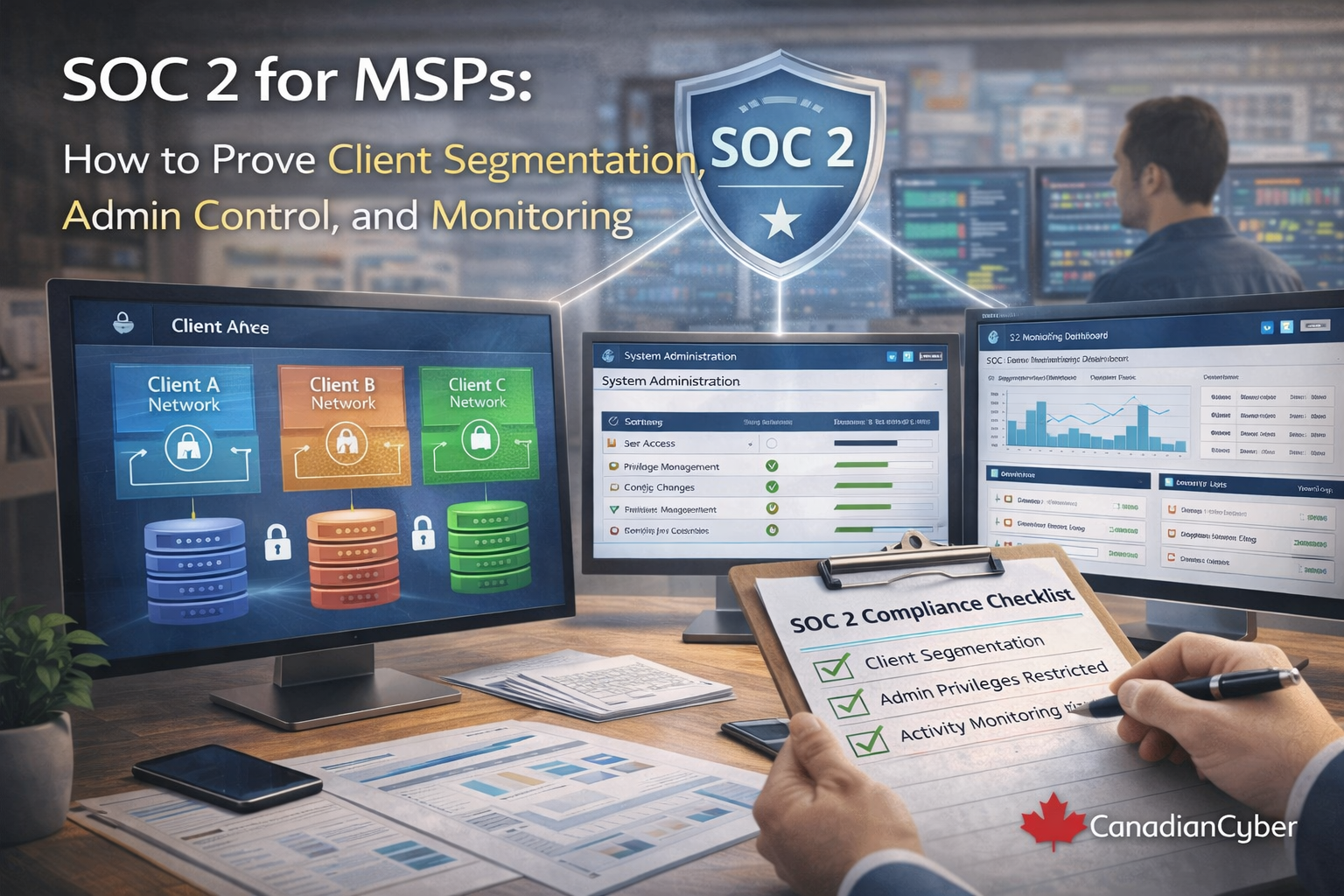
Your clients are not just asking whether you have policies. They want proof that your team can operate securely inside multi-client environments without creating cross-client risk, overpowered admin access, or monitoring gaps that quietly grow into bigger problems.
That is where many MSPs struggle. Not because they do not care about security, but because proving secure operations in a clear, auditable way is harder than it looks.
This is especially true in three areas that clients, auditors, and security reviewers care about most: client segmentation, admin control, and monitoring discipline.
An MSP operates in one of the most sensitive trust positions in the market. Unlike many software vendors, an MSP often has privileged access into multiple client environments, remote administration capability, access to backups and internal support systems, and direct responsibility for alerting, response, or operational continuity.
That means the risk is not only about protecting your own company. It is about proving that your operating model protects each client from unauthorized access, cross-tenant exposure, misuse of privileged accounts, weak monitoring follow-through, and inconsistent operational discipline.
Many MSPs already do a lot of security work. They use RMM tools. They restrict access. They log activity. They rotate passwords. They review alerts. They onboard and offboard technicians.
But when SOC 2 preparation starts, familiar problems show up.
The issue is not always lack of controls. Often, it is the lack of provable control design and repeatable evidence. That is what auditors and client reviewers are really looking for.
Imagine an MSP supporting 40 clients across Microsoft 365, endpoint management, firewall administration, backup tooling, and security monitoring. A large prospective client sends a security questionnaire and asks for SOC 2 readiness detail.
The questions are direct and reasonable.
The MSP has answers in principle, but the proof is fragmented across RMM, Entra ID, PSA tickets, screenshots, verbal reviews, and disconnected logs. Now the team is not just proving security. They are scrambling to reconstruct it.
Many SOC 2 controls matter for MSPs, but three areas tend to attract the most scrutiny and create the most trust risk if they are weak.
Client segmentation is one of the most important security expectations for an MSP. Your clients want to know that one client’s data cannot be viewed accidentally by another, that tooling preserves separation, and that technicians do not have broader cross-client access than necessary.
This matters because MSPs often operate through shared platforms such as RMM tools, PSA systems, remote access platforms, documentation portals, monitoring consoles, backup platforms, and privileged workflows.
| What strong segmentation usually includes | Why it matters |
|---|---|
| Separate client containers, tenants, or workspaces | Creates logical boundaries across core tools. |
| Role-based access limiting technician scope | Prevents broad default visibility. |
| Documented rules for cross-client privileged access | Ensures exceptions are controlled and reviewable. |
| Restrictions around scripts, automation, exports, and ticket visibility | Reduces hidden cross-client exposure paths. |
Auditors and customers will usually want more than verbal assurance. Useful evidence includes RMM role configuration screenshots, tenant grouping design, access matrices by role, admin workflow documentation, access review records, permission settings, and exception approvals for any broader access.
MSPs live on privileged access. That is part of the service model. But it is also where risk concentrates fastest. A compromised or misused admin account inside an MSP can affect many clients at once, along with internal tooling, identity systems, remote sessions, backups, and monitoring workflows.
A mature admin control model usually includes named individual accounts only, least privilege, MFA on all privileged paths, separate admin and non-admin accounts where appropriate, approval and logging for elevated access, scheduled access reviews, rapid deprovisioning, and strong vaulting practices.
One of the most common MSP problems is the belief that everyone needs admin to do their job. That may feel efficient in a fast-moving support environment, but in a SOC 2 context it creates blurred accountability, weak separation of duties, difficult reviews, and much higher misuse risk.
Monitoring discipline is where an MSP’s security maturity becomes visible. Many MSPs say they monitor systems. Fewer can prove that monitoring is defined, triaged consistently, escalated on time, reviewed for quality, and improved after misses.
| Evidence type | What it helps prove |
|---|---|
| Alert triage procedure | Monitoring work is standardized and not personality-driven. |
| Sample alert-to-ticket records | Alerts are investigated, tracked, and closed through a real workflow. |
| Escalation matrix | High-risk events are routed properly. |
| SLA or response metrics | Handling timelines are measured and enforceable. |
| Admin activity monitoring reports | Privileged internal activity is watched, not assumed safe. |
| Quality review records | Monitoring performance is supervised and checked for consistency. |
For MSPs, monitoring discipline should not focus only on client systems. Clients increasingly expect MSPs to show that they can monitor themselves too, including technician access events, remote access use, unusual changes across tools, and high-risk internal actions.
Client segmentation, admin control, and monitoring discipline are not separate stories. They reinforce each other. Weakness in one often undermines the others.
| Area | What it protects | Why it matters |
|---|---|---|
| Client Segmentation | Prevents cross-client exposure | Protects trust in a multi-client operating model |
| Admin Control | Limits privileged misuse or overreach | Reduces internal and external compromise risk |
| Monitoring Discipline | Detects failure, abuse, and missed control operation | Proves controls are actively managed |
Before an audit or client review, MSPs benefit from checking themselves against a short set of practical questions.
If the answer is “mostly” instead of “clearly,” that is usually where remediation should begin.
One of the most expensive mistakes MSPs make is waiting too long to organize evidence. By the time the readiness review or audit period is underway, teams start collecting screenshots and records reactively.
Many MSPs have strong technical capability but uneven control proof. The problem is rarely lack of effort. It is that fast-moving MSP environments often grow through operational necessity: more clients, more tools, more technicians, more privilege, and more monitoring complexity.
Without deliberate governance, that growth can leave gaps in segmentation clarity, admin discipline, and evidence-backed monitoring. For MSPs pursuing SOC 2, the strongest results usually come from simplifying and tightening these three areas first.
SOC 2 for MSPs is not just about showing that tools exist. It is about proving that your operating model is controlled.
That means being able to show, clearly and consistently, that each client is appropriately segmented, privileged access is tightly governed, and monitoring is handled with discipline and evidence.
These are not side topics. They are some of the clearest indicators of whether an MSP can be trusted with high-value access across multiple client environments. In a market where buyers are asking harder questions before they sign, that proof is not just for the auditor. It is a growth asset.