The core problem: your contract clock often starts before your legal clock
Most Canadian privacy laws trigger reporting when you have determined a threshold is met. Contracts often do not. That is the operational tension at the heart of breach reporting in Canada.
Legal trigger logic
Under privacy law, notice usually turns on an assessed threshold, such as whether there is a real risk of significant harm or a risk of serious injury.
Contract trigger logic
Customer contracts often say things like “notify within 24 hours of suspected incident,” “within 48 hours of discovery,” or “within 72 hours of a security event.”
What this means operationally
You can be contractually required to notify a customer before you have confirmed scope, impact, number of affected records, or whether the legal notification threshold is met. A vCISO’s job is to make those clocks compatible.
1) PIPEDA breach reporting: what you must do (and when)
When reporting is required
Under PIPEDA, you must report to the Office of the Privacy Commissioner of Canada (OPC) and notify affected individuals if it is reasonable to believe the breach creates a real risk of significant harm (RROSH).
PIPEDA risk assessment considers things like:
- the sensitivity of the personal information involved
- the probability the information will be misused
- the practical harm that could result if misuse occurs
Timing: the key phrase
PIPEDA guidance uses an important phrase: individuals must be notified as soon as feasible after you have determined that a breach with RROSH has occurred. That means your organization needs a disciplined threshold determination process, not just general incident activity.
Record-keeping: the part teams often miss
Even if a breach does not cross the reporting threshold, you still have record-keeping obligations. You must keep a record of every breach you become aware of and provide it to the OPC upon request.
Operational takeaway:
if your incident log only contains the “big” breaches, your process is already weaker than it needs to be.
2) Quebec Law 25 (confidentiality incidents): what you must do (and when)
Quebec Law 25 uses the concept of a confidentiality incident. If the incident presents a risk of serious injury, you must notify the Commission d’accès à l’information (CAI) and affected individuals, and take steps to reduce risk.
What the notice must include
This is where operational maturity matters. Quebec’s regulation specifies detailed content requirements for notices to the CAI. That means notice quality depends on how well your incident record captures facts during the investigation not what people can reconstruct from memory two or three days later.
Fields you typically need
- what information was affected
- when it occurred or may have occurred
- when you became aware
Population details
- number of persons affected
- number of Quebec residents, if relevant
- which customers, regions, or groups are involved
Assessment and action
- why you concluded there is a risk of serious injury
- mitigation steps taken
- notification timing and rationale
Translation into operations:
your incident record should be designed to support legal notices from the first few hours of investigation onward, not as a last-minute admin exercise.
3) Contract timelines: the hidden compliance risk
Even if you follow PIPEDA and Law 25 perfectly, you can still breach your customer contracts if you notify too late, notify the wrong people, or send something materially incomplete in a way the contract does not support.
| Contract pattern |
Typical wording |
Operational risk |
| Discovery-based |
Notify within X hours of discovery of an incident |
Clock starts before full facts exist |
| Suspicion-based |
Notify within X hours of suspected compromise |
Can force noisy, premature notifications |
| Confirmation-based |
Notify within X hours of confirmed unauthorized access |
More workable, but definitions matter |
| Materiality-based |
Notify only if incident affects customer data or service availability |
Most operationally realistic if well-drafted |
A vCISO goal is to standardize contract language so the company can actually meet its obligations in real incidents rather than theoretically neat ones.
The vCISO breach-reporting playbook that works in Canada
The goal is not to create a legal memo during an incident. The goal is to create a response model that supports timely, accurate, defensible action under pressure.
Step 1: Define three internal incident states
This is how you avoid premature, chaotic notifications and inconsistent language across technical, legal, customer, and executive teams.
Security Event
Unconfirmed
Unusual activity, alert, anomaly, or suspicious signal that still needs validation.
Security Incident
Confirmed
Evidence of compromise, unauthorized activity, or policy breach has been established.
Privacy Breach / Confidentiality Incident
Assessed
Confirmed incident with privacy impact assessment underway or complete.
Then map your obligations like this:
- contract notifications → to incident confirmed or affects customer data/service
- legal notifications → to threshold met (RROSH / risk of serious injury)
Step 2: Set internal triage SLAs to beat contract clocks
A practical model gives the team speed without forcing guesses.
| Window |
Primary objective |
Typical outputs |
| 0–4 hours |
Stabilize and preserve evidence |
Containment decisions, log preservation, incident commander assigned |
| 4–24 hours |
Build preliminary facts |
Systems involved, data types, customers affected, initial risk picture |
| 24–72 hours |
Deepen confirmation and notification quality |
Scope, impacted records, root cause direction, mitigation plan, updated notices |
This does not mean you wait 72 hours to notify. It means your first notice can be accurate and defensible without pretending you know everything immediately.
Step 3: Use a two-stage customer notification method
This solves the biggest tension in Canadian incidents: early contract notice versus incomplete facts.
Stage 1: Initial notice
Early, controlled, low-regret.
- incident type, if known
- affected service area(s)
- containment actions taken so far
- what you are doing next
- whether customer action is needed now
- when the next update will come
Stage 2: Confirmed impact notice
Sent when scope is clearer.
- confirmed data affected, or confirmation of no exposure
- number of impacted accounts or records, if known
- customer-specific impact
- mitigation steps and recommended actions
- regulatory notification status, if applicable
Why this works:
it supports early customer communication without forcing premature legal conclusions or factual overreach.
Step 4: Build a Canada-ready incident record template
Your incident record should capture the fields needed for both PIPEDA assessment and Law 25 notification. This is one of the highest-leverage improvements most organizations can make.
Minimum fields to capture
- discovery date/time and discovery source
- systems involved
- data types and PII categories
- customer and regional impact
- whether Quebec residents may be affected
- risk analysis rationale
- threshold determination and timing
- mitigation actions and timelines
- notification decisions and approvals
- communication log
- regulator contact status
- customer notices sent and update cadence
Step 5: Decide who owns the decision before the incident
The fastest way to blow timelines is decision paralysis. A good breach playbook assigns clear decision ownership before anything happens.
| Role |
Core responsibility |
Why it matters |
| Incident Commander |
Leads operational response |
Prevents drift and confusion during technical response |
| Privacy Lead |
Leads breach risk assessment and legal notice coordination |
Ensures threshold decisions are explicit and documented |
| Comms Lead |
Controls internal and external messaging |
Avoids inconsistent notices and reputational confusion |
| Executive Approver |
Signs off on high-impact notifications and risk acceptance |
Keeps escalation disciplined without blocking action too long |
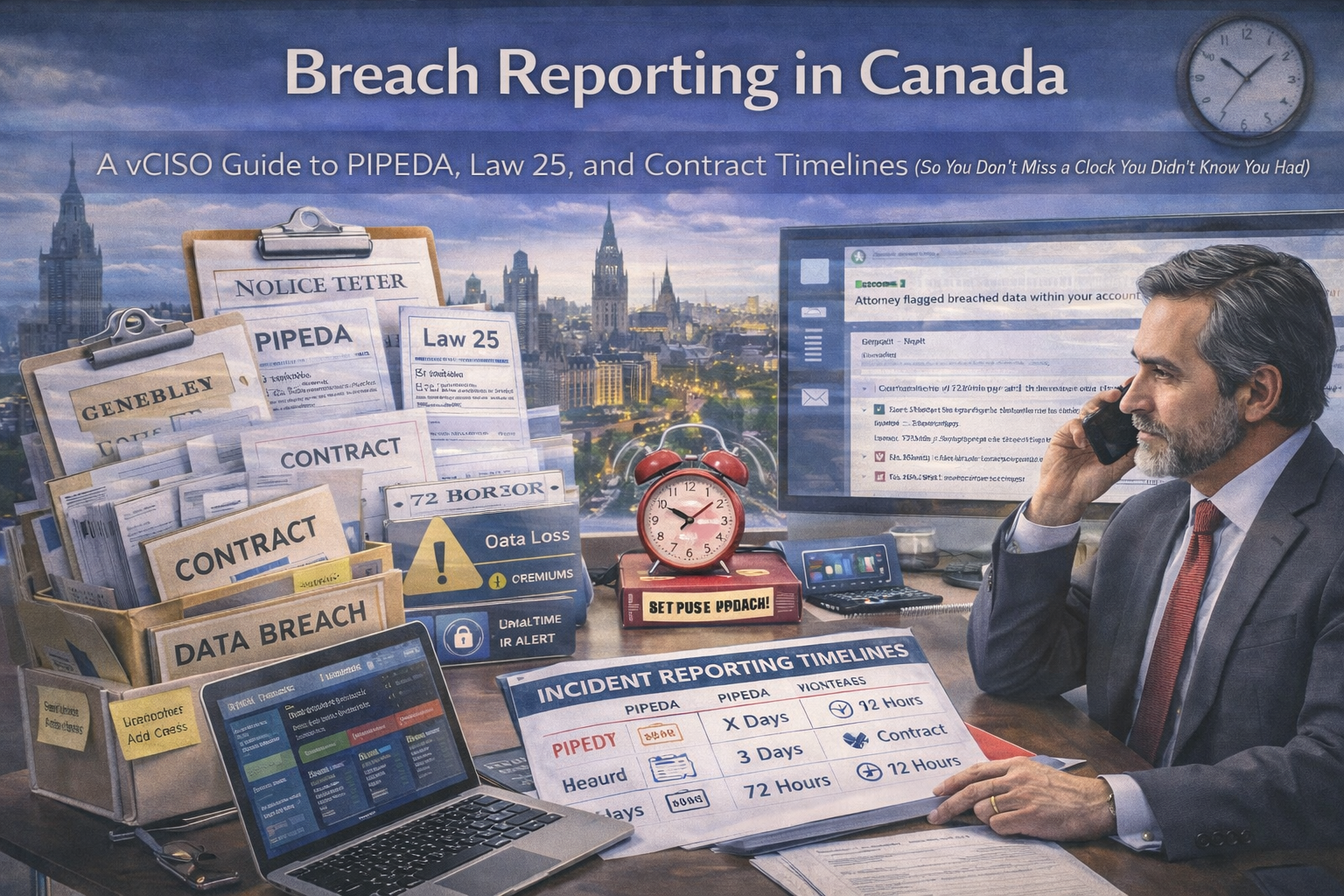
A practical timeline matrix: PIPEDA vs Law 25 vs contracts
Here is the operational reality most teams need to internalize:
- Contracts often require early notice based on discovery or incident confirmation
- PIPEDA requires notice when the RROSH threshold is met, and then as soon as feasible after that determination
- Law 25 requires notice when there is a risk of serious injury, with detailed content expectations
The vCISO takeaway is simple: build a process that supports early customer notice without prematurely triggering legal notices while still meeting legal obligations promptly once thresholds are met.
The contract clause fix: what to negotiate so you can comply
If you’re a vendor, this is one of the highest-impact changes you can make for future incidents. Bad notification language creates noise, legal risk, and impossible expectations. Better language protects both sides.
Problematic language
- “notify within 24 hours of any suspected event”
- “notify within 24 hours of any anomaly”
- “notify immediately upon awareness of any security concern”
Better operational language
- “Notify Customer without undue delay after confirming a Security Incident that affects Customer Data or materially impacts the Service.”
- “Provide an initial notice within X hours of confirmation, and updates as information becomes available.”
- “Regulatory notifications will be handled in accordance with applicable law.”
Why this matters:
it avoids impossible promises while still preserving meaningful, prompt customer notice.
Practical next steps
If you’re not 100% sure your current breach process can meet PIPEDA, Law 25, and your contracts at the same time, fix that before the next incident tests it for you.
Simple, useful ways we can help:
- review your breach notification clauses and incident workflow
- run a tabletop exercise focused on Canadian notification timelines
- build a breach reporting playbook with incident record template and decision matrix
The goal is not just to report on time it is to report on time with control, accuracy, and a process that can stand up afterward.
Follow Canadian Cyber
Practical cybersecurity + compliance guidance: