What a good risk treatment plan must do
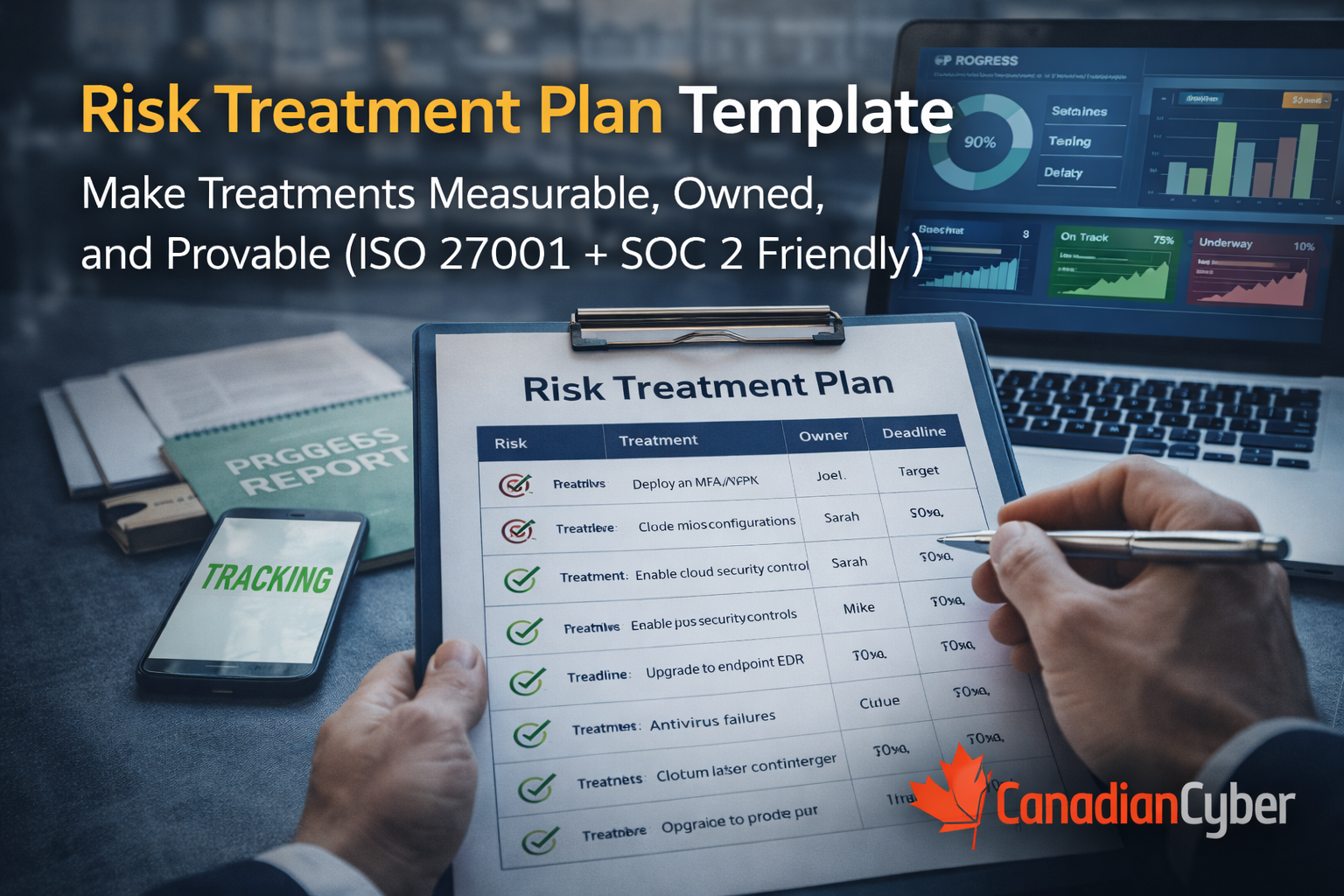
A strong RTP answers six practical questions for every risk. If any of these are missing, treatment stalls, findings repeat, and the plan starts looking decorative instead of operational.
1) What are we treating?
Risk statement, affected assets, and business impact.
2) What strategy are we choosing?
Mitigate, avoid, transfer, or accept.
3) What are we actually doing?
Specific actions, not vague themes.
4) Who owns it?
One named accountable owner.
5) When will it be done?
Dates, milestones, and deadlines.
6) How will we prove it worked?
Metrics, evidence, and verification.
The simplest test:
if an auditor or board member reads the treatment and still cannot tell what will happen next, the plan is too vague.
The vCISO rules for measurable risk treatments
Rule 1: Treatments must be written as outcomes, not activities
The biggest RTP mistake is writing treatments like good intentions. A treatment should describe the end state you expect, not a generic activity label.
| Weak wording |
Better outcome wording |
| Implement MFA |
100% of privileged accounts enforced with MFA and Conditional Access; verified via quarterly export |
| Improve logging |
Cloud audit logging enabled org-wide; alerts configured for privilege changes; monthly log review sign-offs retained |
Rule 2: Every treatment needs a lead metric and a proof artifact
A treatment becomes provable when it produces both a measurable indicator and a retained artifact. If you do not define both at the start, evidence usually gets invented too late.
For each treatment, define:
- a number, status, or pass/fail indicator
- an export, report, screenshot, signed review, or ticket trail
Rule 3: Separate “control implemented” from “control operating”
Auditors care about both. They want to see that the control exists and that it continues to run over time.
Implementation tasks
Setup, configuration, documentation, technical rollout.
Operating tasks
Cadence, reviews, sign-offs, monitoring, recurring evidence.
Rule 4: Don’t treat everything prioritize and timebox
Most teams over-plan and under-deliver. A better model is to focus on the top 10–20 risks, create a 90-day treatment window, and keep a later backlog instead of pretending everything will move at once.
If your treatment actions still sound like themes instead of deliverables, fix the wording first. That one change usually improves ownership, evidence, and follow-through immediately.
Risk Treatment Plan Template (Copy/Paste)
Keep the core structure short and operational. The purpose of the RTP is to make action clear, not to create another long document nobody updates.
Risk Treatment Plan Register (template)
RTP ID: [RTP-###]
Risk ID: [R-###]
Risk Title: [Short name]
Risk Statement: [Threat] could cause [impact] because [vulnerability/exposure] affecting [asset/process].
Scope / Assets impacted: [System, data, process]
Risk Owner (Accountable): [Name / Role]
Treatment Strategy: Mitigate / Avoid / Transfer / Accept (time-bound)
Target Residual Risk: [Low / Medium / High or numeric]
Start Date: [YYYY-MM-DD]
Target Completion Date: [YYYY-MM-DD]
A) Treatment Actions
| Action ID |
Treatment action |
Owner |
Due date |
Dependencies |
Status |
| A1 |
[Specific treatment action] |
[Name] |
[Date] |
[Dependency] |
Not started / In progress / Done |
| A2 |
[Specific treatment action] |
[Name] |
[Date] |
[Dependency] |
Not started / In progress / Done |
| A3 |
[Specific treatment action] |
[Name] |
[Date] |
[Dependency] |
Not started / In progress / Done |
B) Measurement
| Metric type |
Metric |
Baseline |
Target |
Frequency |
Data source |
| Lead |
[% or measurable implementation indicator] |
[Current] |
[Target] |
Monthly / Quarterly |
[Source] |
| Lag |
[Outcome or incident indicator] |
[Current] |
[Target] |
Quarterly |
[Source] |
| Quality |
[Timeliness or completion quality indicator] |
[Current] |
[Target] |
Monthly / Quarterly |
[Source] |
C) Evidence
| Evidence item |
What it proves |
Location / Link |
Owner |
| [Export / report / review record] |
[What it proves] |
[SharePoint link] |
[Name] |
| [Before/after proof] |
[What it proves] |
[SharePoint link] |
[Name] |
| [Operating review sign-off] |
[What it proves] |
[SharePoint link] |
[Name] |
D) Verification
Verification method: Rescan / Test / Sampling / Tabletop / Re-audit / Metric trend review
Verification date: [YYYY-MM-DD]
Verified by: [Independent reviewer / internal auditor / vCISO]
Result: Effective / Partially effective / Not effective
Notes / next steps: [Short, factual]
E) Exceptions / risk acceptance
Exception reason: [Why target date cannot be met]
Compensating controls: [Short, practical list]
Expiry / review date: [YYYY-MM-DD]
Approver: [Named risk owner]
Example: Cloud logging risk treatment
This is the kind of treatment structure auditors trust because it is specific, measurable, and testable.
Risk statement:
Attackers could perform unauthorized changes in cloud environments without detection because audit logs are not centrally collected and reviewed.
Treatment actions
- Enable org-wide logging to a central account or workspace
- Restrict log-delete permissions and alert on “logging disabled” events
- Implement monthly log review sign-off and ticket-based follow-up
Metrics
- Lead: % of accounts or subscriptions sending logs centrally (baseline 40% → target 100%)
- Quality: monthly log review completion rate (baseline 0% → target 100%)
- Lag: time to detect privilege-change events (baseline unknown → target < 24h)
Evidence
- configuration exports and retention settings
- monthly review records
- alert-to-ticket samples
Verification
Run a sample test by disabling logging in a test subscription and confirm the alert triggers and the response occurs.
The 7 most common RTP mistakes
Vague treatments
Fix: convert to measurable outcomes with targets.
No single accountable owner
Fix: assign one named owner who can drive the treatment.
No evidence defined upfront
Fix: add evidence items before work starts, not afterward.
No verification step
Fix: always include a method and date for verifying effectiveness.
Treating too many risks at once
Fix: focus on top risks and timebox the plan.
No linkage to controls
Fix: map each action to relevant ISO Annex A or SOC 2 criteria.
Accepting risk without expiry
Fix: every acceptance needs an expiry or review date.
Next steps
If your risk treatments keep stalling or auditors keep calling them weak, the problem is usually not effort. It is structure.
Final takeaway
A strong risk treatment plan is not impressive because it sounds strategic. It is impressive because it can be executed, measured, evidenced, and verified.
That is what makes treatments credible to auditors, useful to management, and actually valuable to the business. The moment a treatment becomes specific enough to assign, deadline, measure, and verify, it stops being an intention and starts becoming real risk reduction.
The best RTP is not the one that looks polished. It is the one that makes treatments measurable, owned, and provable.
Follow Canadian Cyber
Practical cybersecurity + compliance guidance: